
How to Locate Trophy Bass in Deep Water
Last Updated: November 7, 2026
Quick Summary
To locate trophy bass in deep water, narrow the search before you cast. Mark points, ledges, creek bends, humps and steep banks on a contour map, rank them by season and spawning proximity, then confirm each spot on sonar. Deep water does not automatically mean the deepest water.
- Mark candidate spots: points, ledges, creek bends, submerged humps and steep banks.
- Rank spots near spawning areas or post-spawn routes first.
- Keep the shortlist to about five strong spots rather than many guesses.
- Confirm depth and bottom hardness on sonar before committing to a spot.
- Test the edges of the marked depth band, since fish often sit slightly shallower or deeper.
Table of Contents
- Why Trophy Bass Are Hard to Find in Deep Water
- Using Contour Maps and Lake Maps to Narrow the Search
- Reading Sonar to Find Structure and Fish
- Seasonal Movement and Where Trophy Bass Relocate
- Deep Water Bass Fishing Lures and Depth-Specific Presentations
- Deep Water Crankbait Selection and Retrieve Tips
- How to Catch Bass in Deep Water When Shore Access Is Limited
- Your Next Trip: Building a Deep-Water Plan for Trophy Bass
- Frequently Asked Questions
Why Trophy Bass Are Hard to Find in Deep Water
Locating trophy bass in deep water is harder than most anglers expect. At Just Lures Fishing, we spend a lot of time talking with anglers who have fished the same deep structure all season without a bite. The good news is that the problem is usually a search problem, not a bad-luck problem.
Here's the key idea: deep water does not automatically mean the deepest water.
That contrast is why so many anglers come up empty. They head straight for the deepest basin on the map and assume the biggest fish must be sitting there.
Common reasons trophy bass are hard to pin down:
- Deep water covers a large area, and most of it holds few fish
- Trophy fish often relate to specific structure, not depth alone
- Fish move with the season, the weather and the bait
- Pressure from other boats pushes big bass into quieter spots
A better plan starts with narrowing the search before you ever make a cast.
Using Contour Maps and Lake Maps to Narrow the Search
Maps are your first filter, but most anglers use them as a reference rather than a search tool.
Start with the map features that concentrate fish:
- Points that run out from shore into deeper water, especially long tapering points with a sharp drop on one side
- Ledges where the bottom steps down sharply, particularly those that run parallel to a creek channel
- Creek channel bends that hold bait as water moves and give bass a route between shallow and deep water
- Submerged humps that rise above the surrounding bottom and create an isolated ambush point
- Steep banks where the contour lines crowd together and deep water sits close to shore
Mark every spot that fits, then rank them. The best candidates sit close to a spawning area or a route bass use to move toward deeper water after the spawn.
Keep your list short. Five strong spots beat twenty guesses. For each spot, write down the depth range, the type of structure, and the nearest spawning or bait area. That note becomes your testing plan.
On the water, work the list in order. Start with the spot that best matches the season and water temperature, confirm it on sonar, and fish it thoroughly before moving to the next.
Watch out: map contours are often generalized, and a spot that looks perfect on paper may be silted in or shallower than labeled, always confirm depth and bottom hardness on sonar before you commit to fishing it.
Shortlist on the map, rank by season and spawning proximity, confirm on sonar, and test the depth band systematically.
The article's map workflow boils down to a few steps you can run before you ever leave the dock.
| Step | What to do | Note |
|---|---|---|
| Mark candidate spots | Mark points, ledges, creek bends, humps and steep banks | Use the map's depth labels for each spot |
| Rank the list | Put spots near spawning areas or post-spawn routes first | The best spots funnel fish toward creek channels |
| Keep it short | Shortlist strong spots | Five strong spots beat twenty guesses |
| Log each spot | Record depth range, structure type and nearest spawning or bait area | This note becomes your testing plan |
| Confirm on sonar | Verify depth and bottom hardness before committing | Maps are generalized and can mislead |
| Test the depth band | Work the edges of the marked band, not only the center | Fish often sit slightly shallower or deeper than the map shows |
Reading Sonar to Find Structure and Fish
Your electronics show what the map can only guess at, but the screen is only useful if you can read it.
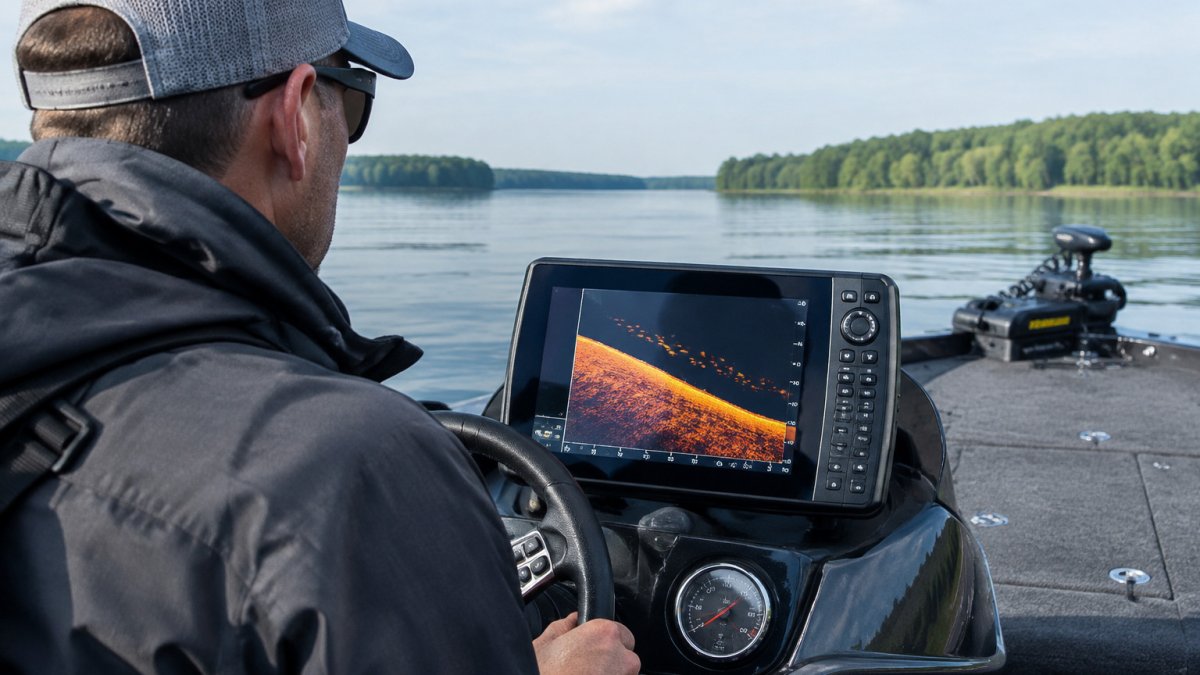
Start by setting up your unit for the depth you are fishing. In 8 to 20 feet of water, a narrower sonar cone and a faster chart speed help you separate a fish from the bottom.
Here is how to read the common returns:
- Hard bottom shows as a bright, thick return with a sharp trailing edge. Rock, gravel, and compacted clay look hard; silt and mud look soft and faint.
- Structure such as standing timber, brush, or rock piles appears as vertical or blocky returns rising off the bottom. Note the height and density, trophy bass often sit on the edge of dense cover rather than inside it.
- Baitfish show as a cloud or ball of small marks, often with a scattered top and a denser core. Bait near structure is a positive sign; bait suspended in open water is less reliable.
- Fish arches close to the bottom are usually bass or other bottom-oriented predators. Arches that float well above the bottom may be suspended fish that are less likely to feed.
A single mark is not a pattern. When you see a promising return, mark the waypoint, turn around, and make a second pass from a slightly different angle. If the mark repeats in the same place relative to the structure, it is likely a fish holding on cover.
Watch out: a large arch directly under the boat is often the transducer reading your own lure or the boat's wake, confirm with a pass from the side before you fish it.
Once you have confirmed a fish or a piece of cover with two passes, drop a marker buoy and fish it thoroughly before moving on.
Sonar interpretation takes practice, so spend time on the water learning what healthy structure looks like on your unit. The goal is not to see every fish, it is to confirm the spots your map shortlisted and to rule out the ones that only looked good on paper.
Seasonal Movement and Where Trophy Bass Relocate
Trophy bass do not hold in one place all year. They shift with the seasons.
In early spring, bass move toward shallow spawning areas. After the spawn, many fish move out to deeper structure to recover and feed. This postspawn movement is one of the best windows for locating big fish offshore.
In summer, bass often hold deep on structure during the heat of the day and move shallower at dawn and dusk. In fall, they follow baitfish as it moves, sometimes returning toward points and creek mouths.
Use a simple decision tree:
- Identify the season and water temperature
- Ask whether the fish are likely postspawn, summer-pattern or fall-feeding
- Match your search to structure that holds bass during that phase
- Work your way out from the most likely spot, adjusting depth as you go
If a spot looks empty, do not give up on the whole lake. Move to the next most likely structure on your map.
Deep Water Bass Fishing Lures and Depth-Specific Presentations
Choosing the right lure depends on the depth you need to reach and how you want the bait to move. Match the lure to the depth range you found on sonar, then vary the speed until you find what works.
Our picks by depth:
- Deep-diving crankbaits for structure that drops well below the surface. The Deep Diving 125 (12 +) reaches depths of 20 feet and beyond, with an adjustable triple-tie bill.
- Mid-depth crankbaits for points and ledges in the 8 to 12 foot range where many trophy fish hold. Browse our Crankbaits selection to compare styles.
- Football jigs for rocky and gravel bottoms, where the jig can bump structure and stay upright.
- Ned rig jig heads for slow, bottom-contact presentations on the most sensitive spots.
Keep the presentation close to the bottom in deep water. Bass that hold deep often want a bait they can see without chasing far.

Deep Water Crankbait Selection and Retrieve Tips
Crankbaits work well when you want to cover water and find where the fish are. Pick a bill and tie position that matches your target depth, then adjust the retrieve.
Here's what we recommend:
- Use the front tie for a tighter, subtle action when you need to reach depth quickly
- Use the back tie for a wide wobble in muddy or cold water
- Cast past the spot, let the lure reach bottom, then start the retrieve
- Bump the bill off structure to trigger reaction strikes
A common mistake is retrieving too fast. Slow down and let the lure stay in the strike zone longer. If you touch bottom, you are in the right place, so keep working that depth.
Want to compare mid-depth options? Mid Depth Crankbait 6 12 is built for those depths.

How to Catch Bass in Deep Water When Shore Access Is Limited
Not every lake offers easy shoreline access. If you fish from a dock, a kayak or a bank with few openings, you still have options.
Focus on the structure you can reach:
- Long casts from the bank to points that run out into deep water
- Fishing from a dock to drop-offs just beyond the shallow shelf
- Working a crankbait parallel to a steep bank to cover the edge
For bottom-contact lures, a football jig works well on rocky edges that you can reach with a long cast. Keep a few spare jigs on hand, since you will lose some on structure.
Your Next Trip: Building a Deep-Water Plan for Trophy Bass
Put the steps together before your next trip. A repeatable plan keeps you from guessing.
Your deep-water plan:
- Check the season and water temperature
- Mark three to five structure spots on the contour map
- Confirm each spot on sonar before you commit
- Start with a crankbait to cover water, then slow down with a jig or Ned rig on the spots that show fish
- Log what you found so next time you start with better information
Braided line helps you handle big lures and fish holding deep, so consider our Fishing Line Braid for your next outing. For more lure ideas, read our guide to the Best Fishing Lures For Trophy Bass In 2026.

Work your map, trust your sonar and stay disciplined about the spots you choose.
Frequently Asked Questions
Where do trophy bass hold in deep water?
The deepest basin is not automatically the best target. Start with the depth where the fish are known to be, then work outward and deeper only as conditions and marks justify it. Look for points, ledges and drop-offs within that range before committing to the deepest water on the map.
What is the best lure for catching bass in deep water?
A deep diving crankbait is one of the most direct tools for covering deep structure quickly. The Whack Em Deep Diving 125 (12 +) is rated to reach 20 feet and beyond, and the Whack Em Deep Diving (0 - 18') model is rated to 18 feet, with an adjustable triple-tie bill that changes how fast the lure dives and how wide it wobbles. For fish holding close to bottom, a Tungsten Ned Jig or football jig can keep the bait in contact with the structure longer. Match the lure's diving depth to the depth you have marked on your sonar.
How do you catch bass in deeper water from shore?
Shore anglers can reach deeper structure by casting farther along points, drop-offs and channel edges that run close to the bank. A deep diving crankbait with a long-casting profile lets you reach fish holding away from the shore, and a football jig worked slowly along the bottom covers the same structure with a different presentation. Count your casts and vary the retrieve depth until you find the zone where bites happen, then repeat that pattern along the shoreline.
How do you use a fish finder to locate deep-water bass?
Scan the bottom for changes in depth first, such as ledges, humps and steep banks, then look for fish marks sitting just off that structure rather than directly on top of it. Trophy bass often hold on the edge of a drop, so watch for arches or clusters of marks near the break. Mark productive spots with GPS, note the depth they sit at, and return to them with a lure that runs at that depth.
