
How to Choose Lures for Pond Fishing: 2026 Guide
Table of Contents
- Start With Depth and Cover, Not the Lure Aisle
- Best Pond Fishing Lures for Shallow, Weedy Water
- Pond Bass Fishing Lures: Matching Forage and Seasonal Patterns
- How to Choose Fishing Lure Color for Murky vs Clear Ponds
- Lure Maintenance and Storage for Pond Hopping
- Species Beyond Bass: Trout, Bluegill, and Panfish
- Fishing Pressure, Ethics, and Catch-and-Release in Small Ponds
- Conclusion
- Frequently Asked Questions
Last Updated: October 14, 2026
Start With Depth and Cover, Not the Lure Aisle
Most ponds are less than 20 feet deep, and that single fact should drive how to choose lures for pond fishing.
Consistent anglers match one or two lures to the water in front of them, not the fullest boxes.
So before you buy anything, answer two questions:
- How deep is the deepest water you can reach from shore?
- What kind of cover sits between you and that depth?
Those answers narrow your choices fast: a 6-foot pond with matted milfoil needs different tools than a 15-foot pond with a clean gravel bank.
Here is the framework we use, and the lures that fit each scenario.
Why Most Ponds Reward Small Profiles
Small lures catch more fish in ponds.
FishUSA's guide to pond bass lures recommends 4- to 5-inch soft plastics for typical pond environments, and that matches what we see.
But small does not automatically mean better. Public Lands' analysis of lure sizing notes that while small lures attract more fish, they tend to catch smaller fish.
The balance: downsize your profile but keep your presentation natural. A 5-inch stick worm fished slowly beats a 4-inch bait burned past cover.
Best Pond Fishing Lures for Shallow, Weedy Water
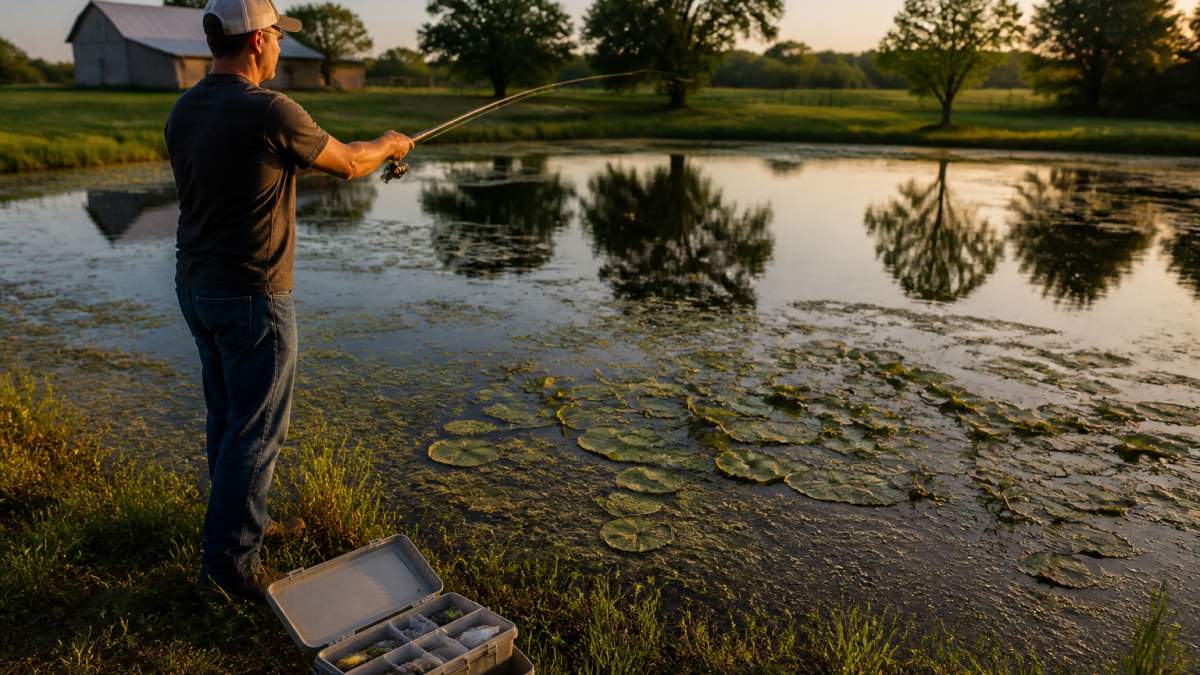
Shallow, weedy ponds demand lures that come through cover without snagging. The best pond fishing lures for this water fall into two families: weedless topwater and weedless soft plastics.
Topwater Frogs for Matted Vegetation
A hollow body frog is the most effective lure for matted grass, lily pads, and slop. It floats, walks, and its hooks sit tight against the body, sliding over vegetation that would snag anything else.
Our Whack Em Hollow Body Frog is built for exactly this.
Fish it slow. Twitch, pause, twitch. When a bass blows up, wait a beat before setting the hook. That pause is the hardest part and the most important one.
Texas-Rigged Worms and Stick Baits
When bass will not commit to the surface, switch to a Texas-rigged worm or a weightless stick bait. Realtree's farm pond lure guide calls a 7-inch ribbon-tailed worm "mandatory equipment," fished on a Texas rig with 1/16 to 1/4 ounce weights.
A stick bait like the Slinger 5 does the same job with a subtler fall. Rig it wacky or weightless and let it quiver down through the water column.
Pond Bass Fishing Lures: Matching Forage and Seasonal Patterns
Pond bass fishing lures work best when they match what the fish are eating that week. The mistake most anglers make is fishing the calendar instead of the pond, a shallow 3-acre pond warms two to three weeks ahead of a deep 15-acre pond ten miles away, so the same date can mean pre-spawn in one and post-spawn in the other.
Here is the forage-to-lure logic that drives every seasonal decision:
- When bass are keyed on crawfish (typically pre-spawn and early fall), use bottom-contact baits that mimic a defensive crawfish: Texas-rigged creature baits, jigs with craw trailers, and dark red, brown, or black-and-blue colors.
- When bass are keyed on bluegill (late spring through summer, especially around beds and shallow cover), use bluegill-patterned swim jigs, small spinnerbaits, and squarebill crankbaits in bluegill or chartreuse-and-blue.
- When bass are keyed on shad or minnows (open-water summer and fall), use lipless crankbaits, small swimbaits, and flukes in shad or silver patterns.
Spawn, Post-Spawn, and Summer Shifts
Pre-spawn (water 50-60°F): Bass move shallow and feed heavily before bedding.
Spawn (water 60-68°F): Bass are on beds in the shallows.
Post-spawn (water 68-75°F): Fish are tired, scattered, and slow, so finesse wins.
Summer (water 75°F+): Bass either go deep to the pond's deepest available water or tuck under shade and vegetation. According to Wired2Fish's August 2026 lure report, experts recommended bigger profile baits during rising water temperatures, specifically 10-inch Power Worms in colors like blue fleck and red bug. For a middle path, a hollow body frog fished over matted vegetation in low-light hours covers water fast and triggers reaction strikes.

Fall (water 60-70°F): Bass feed aggressively to bulk up for winter, the best time for moving baits like spinnerbaits, squarebills, and lipless cranks.
Winter (water below 50°F): Pond bass are lethargic and deep.
Reading Forage Activity in a Pond
You do not need sonar to figure out what pond bass are eating. Watch the water:
- Bluegill beds: Saucer-shaped depressions in shallow gravel or sand mean bass are nearby.
- Shad flicking: Silver flashes on the surface at dawn and dusk mean bass are chasing shad, throw a shad-patterned moving bait.
- Crawfish shells: Molted shells on the bank mean bass are feeding on crawfish, switch to bottom baits in brown or red.
This forage-first approach separates anglers who catch pond bass consistently from those who just own a lot of lures.
How to Choose Fishing Lure Color for Murky vs Clear Ponds
Water clarity decides your color choice, the fastest decision you will make all day.
In murky water, bass rely on vibration and silhouette more than sight. The Wired2Fish color guidance notes that natural color palettes work better in summer when vegetation improves water clarity.
In clear water, go natural: watermelon, green pumpkin, shad patterns, and translucent finishes. Bass in clear ponds get a long look at your bait, so realism matters more than flash.
Here is the quick reference we use:
| Water Clarity | Best Colors | Add-Ons |
|---|---|---|
| Murky, stained | Black, blue fleck, chartreuse | Rattles, scent |
| Slightly stained | Green pumpkin, June bug | Rattle or none |
| Clear | Watermelon, shad, natural | Finesse, lighter line |
| Clear and pressured | Translucent, subtle flake | Silent baits, downsized hooks |
One more note: pressured ponds change everything. Bass that see lures daily become line-shy and color-shy.
Lure Maintenance and Storage for Pond Hopping
Pond hopping wrecks tackle faster than lake fishing, mud, grit, and repeated snags wear hooks, tear soft plastics, and rust hardware. A few habits keep your box in shape:
- Rinse hard baits in fresh water after every trip and dry before storage
- Replace treble hooks at the first sign of dullness or rust
- Store soft plastics flat and out of direct sun to prevent melting and color bleed
The Slinger 5 is built from high-durability plastic that survives multiple catches, stretching your dollar on structure-heavy ponds.

Species Beyond Bass: Trout, Bluegill, and Panfish
Not every pond holds bass, and even bass ponds have panfish worth targeting. Many ponds are stocked with multiple species that respond to the same selection logic, just scaled down.
Bluegill and Panfish
Bluegill, redear, and other panfish are the most common pond residents after bass.
Best panfish lures:
- 1/16 to 1/8 oz jigs with small grubs: According to community discussion on r/bassfishing, these micro lures are a go-to for late spring and summer pond fishing when panfish crowd the shallows. Fish them under a small bobber or slow-retrieve them along the bottom.
- Small inline spinners (size 0-2): Silver and gold blades work well in clear water; chartreuse and orange work in stained water. These catch bluegill, crappie, and even small bass.
- Tiny crankbaits (1-2 inches): Crank them slowly along weed edges. Panfish will chase them down.
Where to find them: Panfish stack in shallow water near cover, weed edges, fallen trees, dock pilings, and rocky banks.
Why this matters for bass anglers: Panfish are a primary forage for pond bass. If you find active panfish, bass are usually nearby, catch a few on a small jig to locate the bass, then upsize.
Crappie
Crappie are less common in small ponds than bluegill, but when present they can be the most catchable fish in the water, schooling tightly around brush piles, dock pilings, and submerged timber.
Best crappie lures:
- 1/16 to 1/8 oz jigs with curly-tail grubs: White, chartreuse, and pink, fished vertically around structure or under a slip bobber.
- Small minnow-style swimbaits: Mimic the small minnows crappie feed on; fish slowly on a jighead.
- Tiny crankbaits and spinners: Work when crappie are suspended and chasing.
Crappie suspend at a specific depth, so a slip bobber beats blind casting. Start at 3-5 feet and adjust until you find the school.
Stocked Trout
Some ponds are stocked with rainbow, brown, or brook trout, especially in cooler climates or during fall and winter. Trout need cooler, well-oxygenated water, so look near springs, inlets, or deeper pockets.
Best trout lures:
- Small inline spinners (size 0-2): Silver, gold, and black-and-yellow, fished on light line with a slow, steady retrieve.
- Tiny crankbaits (1-2 inches): Trout- or minnow-patterned, cast parallel to the bank and retrieved steadily.
- Spoons (1/8 to 1/4 oz): Let them sink and retrieve with a flutter, trout strike on the fall.
Trout tactics: Fish early morning or late evening when water is coolest, use a 4-6 lb fluorocarbon leader, and target the stocking point for the first few days after a plant.
Catfish
Catfish are the bottom-dwellers of the pond world. They are not typically targeted with lures, but they will take them occasionally.
Best catfish lures:
- Soft plastics on a jighead: Fished slowly on the bottom, these catch channel cats.
- Small spinnerbaits: Fished deep and slow, these occasionally trigger strikes.
- Cut bait or worms on a circle hook: The most effective approach, but it is bait fishing, not lure fishing.
To target catfish with lures, fish the bottom near deep structure with a slow, dragging retrieve. Expect fewer bites than with bait, but explosive strikes.
The Universal Multi-Species Principle
The principle stays the same across species:
- Match the size of the forage. A bluegill cannot eat a 5-inch stick bait; a bass can. Scale your lure to the mouth size of your target.
- Match the color to water clarity. Dark colors in murky water, natural colors in clear, for panfish, trout, and catfish just as for bass.
- Match the action to water temperature. Cold water means slow down; warm water means speed up. Trout and panfish are more sensitive than bass.
If you are introducing a kid to pond fishing, a small jig under a bobber will out-fish almost anything else. And if you are a bass angler, paying attention to other species will make you better, the food chain tells you where the predators are.
Fishing Pressure, Ethics, and Catch-and-Release in Small Ponds
Small ponds feel fishing pressure faster than any lake, a 2-acre pond with three regular anglers can produce noticeably fewer bites within a season. That makes ethics practical: handle fish with wet hands, support the belly on bigger bass, and get them back in the water quickly.
A few rules we follow on pressured ponds:
- Release every bass over 3 pounds so the genetics stay in the pond
- Avoid fishing beds during the spawn
- Rotate ponds instead of hammering one spot
Ponds are shared resources. Treating them well keeps the fishery alive for the next angler, including you next spring.
Conclusion
Choosing lures for a pond is not about owning everything. It is about reading depth, cover, clarity, and season, then picking two or three baits that fit.
Just Lures Fishing carries a curated lineup built for exactly this kind of fishing.
Get started with Just Lures Fishing and put the right lure in front of every pond bass you chase.
Frequently Asked Questions
What is the best lure for catching pond trout?
Pond trout respond to different profiles than bass. Small inline spinners, 1/16 to 1/8 oz jigs tipped with grubs, and compact spoons work because trout in ponds feed heavily on stocked pellets and small baitfish. Match the hatch: if the pond holds bluegill, a shad-colored or silver lure imitates that forage. Fish these on light line and a slow, steady retrieve near drop-offs or inflow points where colder, oxygenated water collects. Trout are more line-shy than bass, so downsize your leader and keep casts long.
How do you choose the right fishing lure color for stained or muddy ponds?
Stained and muddy water limits how far bass can see, so contrast and vibration matter more than realism. Chartreuse, black-and-blue, and firetiger patterns with rattles or blades create a silhouette fish can track. In clearer ponds, natural shad, watermelon, and green pumpkin tones work because bass get a good look at the bait. The Whack Em Lipless Rattler pairs a loud internal rattle chamber with a tight wobble, which helps fish locate it in low-visibility water without relying on color alone.
Do small lures always catch more pond bass?
Not always. Small lures in the 4- to 5-inch range attract more strikes in typical ponds, but they also tend to catch smaller fish. If you are chasing a trophy, sizing up to a 7- or 10-inch worm or a bigger swimbait can filter out dinks. A practical approach is to start small to locate active fish, then upsize once you know bass are feeding. Keep a few larger profiles in your tackle box for that second pass.
How many lures do I actually need for pond fishing?
You can cover most pond scenarios with five or six baits: a hollow body frog for slop, a stick worm for weightless or wacky rigging, a Texas-rigged worm, a lipless crankbait for covering water, a small spinnerbait, and a soft plastic jerkbait. That mix handles shallow cover, open water, and pressured fish without overloading your tackle box. Add a couple of color variants for clarity changes and you are set for a full season of pond hopping.