
Best Chance of Success: Durable Fishing Tackle
Table of Contents
- Why Durable Fishing Tackle Gives You the Best Chance of Success
- Essential Lures for a Tackle Box: The Core Five
- How to Choose Fishing Lures That Match Conditions and Forage
- Best Fishing Lures for Beginners: Start With Versatility
- Soft Plastic vs Hard Bait: Which Belongs in Your Box?
- Cost Per Catch and Tackle Maintenance: Protect Your Investment
- Conclusion: Build a Box That Works
- Frequently Asked Questions
Last Updated: October 9, 2026
Why Durable Fishing Tackle Gives You the Best Chance of Success
Angler experience matters less than lure choice, according to research published in Fisheries Research. That finding flips the usual advice on its head. The rod holder's skill gets the credit, but the lure in the water does the persuading.
At Just Lures Fishing, we sell premium artificial baits we use ourselves, so this isn't theory for us. Durable fishing tackle is gear built to survive repeated strikes, structure contact, and seasons of use without failing at the moment a fish commits. That reliability is what separates a full box from a box of regrets.
Here's the uncomfortable part most guides skip: a lure that fails after three casts isn't cheap. It's expensive. Below, we break down the core lures worth owning and how to match them to conditions.
Essential Lures for a Tackle Box: The Core Five
Five lure types cover nearly every freshwater situation a bass angler faces. Build around these and you stop guessing.
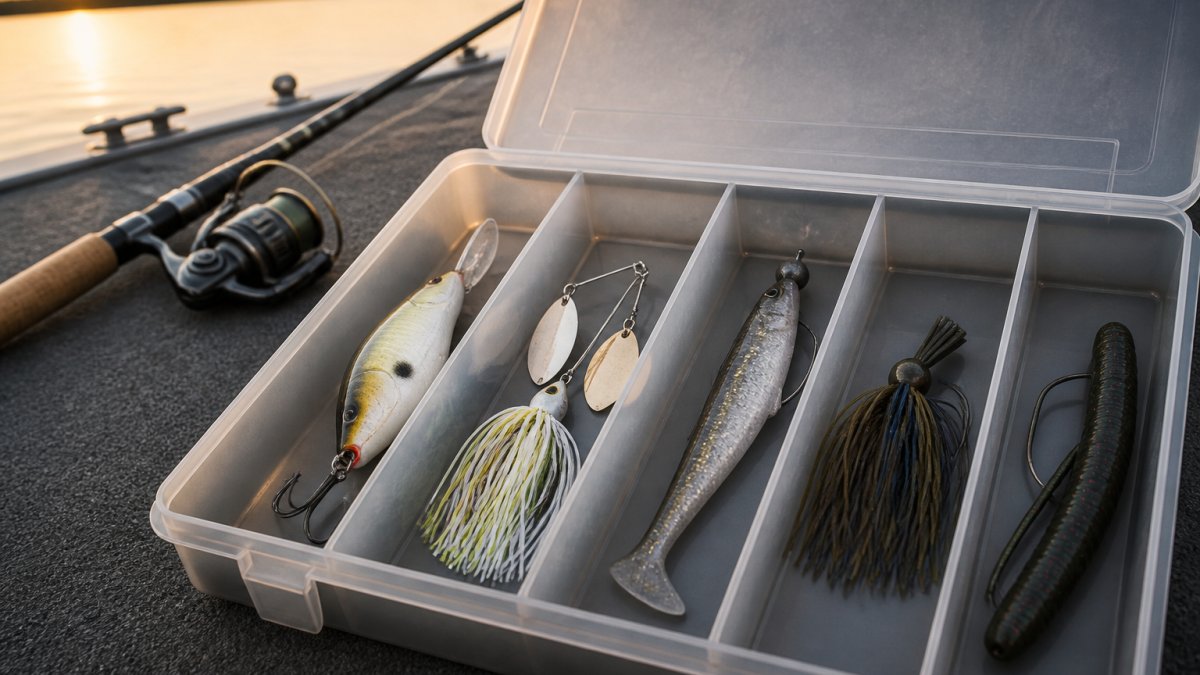
The five core categories are:
- Crankbaits for covering water at a set depth
- Lipless crankbaits for vibration and sound in stained water
- Shakey head jigs for finesse presentations around docks
- Football jigs for rocky and gravel bottoms
- Swim jigs for moving presentations through cover
Our Crank 8 dives to 8 feet with a rounder belly that produces a different wobble and vibration than a standard crankbait. It carries oversized 3D holographic eyes and a rattling action for calling fish in. The Rattler takes the sound approach further with an internal rattle chamber, effective in cooler water when bass turn sluggish. For bottom work, the Shakey Jig locks soft plastics in place with a heavy-duty spring, and the Football Jig deflects off rock and gravel while staying upright. The Swim Jig rounds out the set with a fuller skirt profile and a weed guard for heavy cover.

How to Choose Fishing Lures That Match Conditions and Forage
Choose fishing lures by answering three questions: what are the fish eating, how clear is the water, and how deep are they holding? Columbia Sportswear's guide to fishing bait and lures notes that tackle selection confuses many anglers and recommends choosing based on conditions and target species rather than hunting for one universal best option.
Water clarity drives your color and sound choices. Stained or murky water calls for rattling baits and brighter color patterns, which is where the Rattler's loud internal chamber earns its place. Clear water favors natural forage matching and subtler presentations. Depth control comes next: a lure that runs at the wrong depth never gets seen, no matter how good it looks.

| Condition | Lure Choice | Why It Works |
|---|---|---|
| Murky water, cold | Rattler | Loud rattle triggers strikes |
| Rocky bottom | Football Jig | Deflects off structure, stays upright |
| Docks and brush | Shakey Jig | Skips under cover, holds plastics |
| Shallow weed beds | Swim Jig | Weed guard clears cover |
| Mid-depth flats | Crank 8 | Dives to 8 feet, rattles |
Best Fishing Lures for Beginners: Start With Versatility
The best fishing lures for beginners are versatile ones that work across multiple conditions. beginner-focused guidance on YouTube makes the same point: versatile and easy to use beats specialized and complicated when you're learning.
Beginners lose lures. That's not a flaw in the angler; it's part of learning structure and depth. Which means durable construction isn't a nice-to-have for a new angler.
A versatile angler builds a small box that covers water rather than a large box that covers every hypothetical. Start with three lures: a crankbait for open water, a jig for bottom contact, and a swimbait for moving presentations. Learn each one's action before adding more.
Soft Plastic vs Hard Bait: Which Belongs in Your Box?
Soft plastics and hard baits do different jobs, and a complete box carries both. The question isn't which is better. It's which one fits the situation in front of you. The deeper question is why each type behaves the way it does, because that mechanism tells you when to switch.
Soft plastic lures are flexible bodies that move naturally in the water and pair with jig heads. Their action comes from two sources: the angler's rod tip and the trailer's own flutter. That dual input is why soft plastics excel around cover. When a bass inhales a soft plastic, the plastic collapses and the hook point stays exposed. The trade-off is casting distance and durability. A soft plastic tears after a few fish, and its lighter weight limits how far you can throw it into wind.
Hard baits are rigid-bodied lures with built-in action, like crankbaits and lipless rattlers. Their action is engineered into the body: the lip angle, the internal weighting, and the line-tie position determine dive depth, wobble frequency, and deflection behavior. That engineering is why hard baits cast farther, dive predictably, and hold their action at speed. The trade-off is hook exposure. A treble-hook bait that rolls into cover gives a bass leverage to throw the hook, and a chipped lip or cracked body changes the action permanently.
| Factor | Soft Plastic | Hard Bait |
|---|---|---|
| Best around | Docks, brush, grass | Open water, rock, flats |
| Snag resistance | High with weedless rigging | Moderate |
| Casting distance | Shorter | Longer |
| Action source | Angler and trailer | Built into the body |
| Hook exposure on strike | High (plastic collapses) | Lower (rigid body blocks) |
| Durability per bait | Tears after several fish | Survives until lip or body fails |
| Typical pairing | Shakey Jig, Football Jig | Crank 8, Rattler |
A common mistake is fishing a hard bait through heavy cover and losing it on the first cast. Match the bait type to the structure, not to your favorite lure. The other mistake is fishing a soft plastic in open water where a hard bait's built-in action would cover more ground faster. Neither bait type is universal. The angler who understands why each one works picks the right tool instead of forcing a favorite into the wrong situation.

Cost Per Catch and Tackle Maintenance: Protect Your Investment
Cost per catch is the real price of a lure, not the sticker price. A bait that lands fish for two seasons costs less per fish than a bargain lure that fails in a month.
Here's the framework most anglers never build. Divide the lure's price by the number of fish it lands before it fails. A budget crankbait that costs a few dollars and lands a handful of fish before the hooks bend or the lip cracks has a higher cost per catch than a premium bait that costs more upfront but lands fish across multiple seasons.
Better hardware means fewer lost fish and fewer mid-trip replacements.
Terminal tackle and maintenance protect that investment. Each step below targets a specific failure mode:
- Check hooks after every snag. A bent point costs fish because it can't penetrate past the barb. Run a fingernail along the point; if it scratches, the hook is still sharp. If it slides, replace it.
- Rinse lures in fresh water after salt or muddy sessions. Salt corrosion pits hook plating and split rings, and grit in the line tie abrades knots.
- Replace skirts and trailers before they tear, not after. A torn skirt changes the bait's profile and vibration signature, which is what triggered the strike in the first place.
- Store baits in a dry box to prevent rust on hooks and split rings. Moisture trapped in a closed box is the single fastest way to ruin terminal tackle between trips.
- Retie knots after every few fish or any hard strike. A knot weakened by a strike can fail on the next hook set, and that lost fish costs more than the thirty seconds it takes to retie.
Our jigs are built for this reality. The Shakey Jig uses a chip-resistant finish and a heavy-duty retention spring, and the Swim Jig pairs a Mustad wide-bend hook with a recessed line tie and weed guard. Durable construction means less time swapping baits and more time with a line in the water. But construction only gets you so far. The angler who rinses, checks, and stores their baits gets more casts per bait than the angler who doesn't, and that difference shows up in cost per catch at the end of the season.
Conclusion: Build a Box That Works
The gap between a frustrating season and a productive one usually comes down to gear that holds up and lures that match the water in front of you. Just Lures Fishing carries the exclusive Whack Em Lures line, made just for us, from the Rattler and Crank 8 to the Shakey Jig, Football Jig, and Swim Jig. Every bait is one we trust and fish ourselves. Shop swimbaits and build a box that gives you the best chance of success on every cast.
Frequently Asked Questions
Which fishing lures should every angler have in their tackle box?
Start with five core types: a diving crankbait like the Crank 8 for covering water from 0 to 8 feet, a lipless rattling bait like the Rattler for murky or cold water, a Shakey Jig for skipping under docks, a Football Jig for rocky bottoms, and a Swim Jig for heavy cover. These five cover most depths, water clarities, and target species you will face.
Is it better to use one versatile lure or several specialized lures?
A small set of versatile lures beats a box full of one-trick options. The Rattler works in both shallow and deep water with different retrieve speeds. The Swim Jig handles heavy cover and open water. Carry a few lures that each do several jobs well, then add specialized baits only when you know your local conditions demand them.
How do you choose a durable fishing lure that lasts?
Look for high-impact construction, chip-resistant paint, and quality hooks. The Rattler uses high-impact materials to survive repeated strikes against structure. The Shakey Jig has a heavy-duty bait-retention spring and chip-resistant finish. The Football Jig features a Mustad Ultra Point hook and a durable nylon weed guard. These details separate tackle that lasts from tackle that fails after a few casts.
What makes a fishing lure effective in different water conditions?
Match the lure to water clarity, depth, and cover. In murky water, use rattling baits like the Rattler that fish can find by sound and vibration. In clear water, natural color patterns and realistic action matter more. For heavy cover, choose snag-resistant jigs with weed guards like the Swim Jig or Football Jig. Depth control comes from lure weight and retrieve speed.
What is the 80/20 rule in bass fishing?
The 80/20 rule suggests that roughly 80 percent of your catches come from about 20 percent of your lures. In practice, that means a handful of versatile, durable baits do most of the work. Focus on lures that cover multiple depth ranges and trigger strikes in varied conditions, like the Crank 8 or the Rattler, rather than buying dozens of specialized baits you rarely use.