
Does Water Temperature Really Change Winter Bass Fishing?
Quick Summary
Water temperature controls how active winter bass are. As the water cools, bass slow their metabolism, feed less often, and wait for food to come to them, so slow, precise presentations usually work better than fast ones. Measure the reading before you launch and match your lure and retrieve to it.
- Bass are cold-blooded, so their metabolism slows as the water cools.
- Below 40°F, fish feed rarely and only on easy meals.
- At 50°F, bass position on drop-offs, points and channel edges.
- In the mid-40s, use a slow, steady retrieve and keep lures near the bottom.
- After a sharp cold front, give bass a day or two to settle before fishing hard.
Table of Contents
- How Water Temperature Affects Bass Metabolism in Winter
- Bass Fishing Water Temperature Chart for Winter Conditions
- Bass Fishing in 50 Degree Water: Where Fish Position and Feed
- Bass Fishing in 45 Degree Water: Slowing Down Your Presentation
- Stable Temperatures Versus Sudden Swings: What Changes the Bite
- Winter Bass Fishing Lures Matched to Water Temperature
- Planning Your Next Winter Trip Around the Thermometer
- Frequently Asked Questions
How Water Temperature Affects Bass Metabolism in Winter
Last Updated: November 4, 2026
Water temperature is the single biggest factor in how bass behave during winter. As the water cools, bass slow down, and that changes how and where you should fish. This guide from Just Lures Fishing breaks down what happens in the water and what to do about it.
Bass are cold-blooded. Their body temperature rises and falls with the water around them. When the water drops, their metabolism drops too. A slower metabolism means less energy needed, so bass eat less and less often.
Bass metabolism is the rate at which a bass burns energy, and it moves in step with water temperature.
Here is the practical takeaway: a cold bass does not chase. It waits for food to come close and then takes it with a short, easy effort. That is why aggressive lure work often fails in winter, while slow, precise presentations get bites.
Watch out: many anglers keep the same fast retrieve they used in summer. A sluggish bass will ignore it, so slow down before you blame the fish.
Bass Fishing Water Temperature Chart for Winter Conditions
Most anglers guess at water temperature. A simple thermometer removes the guesswork, but the reading only helps if you know what to do with it. Use the chart below as a starting point, then adjust for your lake and the trend you observe.
| Water Temperature | Bass Activity | Where to Fish | Lure and Retrieve |
|---|---|---|---|
| Below 40°F | Very sluggish; feeds rarely and only on easy meals | Deepest available structure, main-lake points, channel bends, rockpiles | Finesse jig or Ned rig dragged slowly on bottom; long pauses; few casts per spot |
| 40-45°F | Slow but willing to eat a well-placed bait | Deep cover adjacent to drop-offs; sun-warmed rock or wood | Suspending jerkbait with long pauses; slow-rolled swimbait; dead-sticked creature bait |
| 45-50°F | Moderately active; short feeding windows | Channel edges, points, secondary points, baitfish schools | Crankbait on ledges; jerkbait; slow spinnerbait; moderate retrieve with pauses |
| 50-55°F | Active enough to chase | Shallower structure, flats near deep water, windblown banks | Lipless crankbait, squarebill, swimbait; steady retrieve with occasional kill |
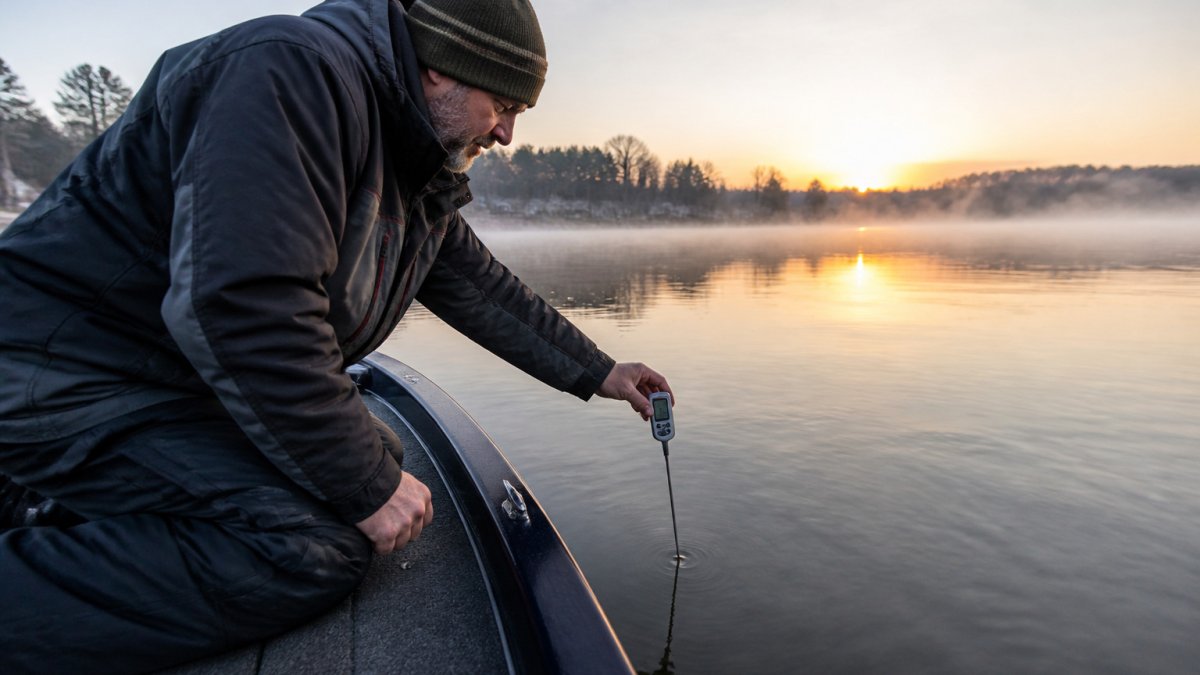
How to measure and interpret the reading: Take the surface temperature at the ramp, then lower the probe a few feet at a time over the deepest structure you plan to fish. In winter, surface water can be colder than water a few feet down, and bass often hold where the temperature is most stable. Record the reading, the depth, the time of day, and the air temperature. Over several trips, a pattern emerges: if the deep reading holds steady while the surface swings, fish the deep zone; if the whole column warms after a mild front, check shallower structure in the afternoon.
A common pattern is that the first reading of the morning is the coldest; take a second reading after lunch to see how much the sun has warmed the shallows. Compare that trend to the previous trip rather than relying on a single number.
Watch out: a thermometer left in direct sun or stored in a warm tackle box can read several degrees high. Shade it and let it equilibrate before trusting the number.
According to guidance from the National Oceanic and Atmospheric Administration water temperature resources, local water temperature data can help you plan a trip before you launch.
Bass Fishing in 50 Degree Water: Where Fish Position and Feed
At around 50 degrees, bass start to move, but they do not go far. This is the transition zone where fish are neither fully deep nor fully shallow.
Where they position: Look for bass on the first drop-off adjacent to spawning flats, on secondary points that run toward deeper water, and along channel edges where baitfish schools suspend. In natural lakes, weed edges that are still green hold fish; in reservoirs, main-lake points and bluff banks with rock transitions are prime. Depth is usually 8-15 feet in clear water and 4-8 feet in stained water, depending on how much sun has warmed the shallows.
How they feed: Bass at 50 degrees still feed, but they prefer easy meals close to their holding spot. They will rise a few feet for a slow-moving bait but rarely chase a fast one across the flat. A common pattern is a short morning window on deeper structure, then a move shallower in the afternoon as the sun warms the bank.
What to throw: A suspending jerkbait worked with two or three long pauses, a slow-rolled swimbait along the drop-off, or a lipless crankbait ripped and killed near the bottom. Keep the lure in the strike zone longer by casting parallel to the structure rather than straight at it.
Lake-type adjustments: In rivers, fish current breaks and eddies where water is slightly warmer; in shallow ponds, the entire water body may sit near 50 degrees, so focus on the deepest hole and any remaining green vegetation; in highland reservoirs, concentrate on steep rock and channel swings.
Watch out: a warming trend can pull fish shallower faster than expected, so check the shallow flat before committing the whole day to deep structure.
Bass Fishing in 45 Degree Water: Slowing Down Your Presentation
Once the water drops into the mid-40s, bass become very selective. They hold tight to cover and move only short distances. A fast lure may spook them, while a slow, lifelike one can tempt a bite.
Try these steps when the water is this cold:
- Use a slow, steady retrieve or a dead-stick pause
- Keep your lure close to the bottom
- Make fewer casts, but fish each spot longer
- Pick baits with a subtle, natural action
If you struggle to get bites in cold water, the problem is usually speed, not location. Slow your presentation down and give fish more time to decide.
Stable Temperatures Versus Sudden Swings: What Changes the Bite
Stable water temperature keeps bass in a steady routine. Sudden swings, such as a cold front that drops the water several degrees in a day, can shut the bite down for a while.
After a sharp drop, bass often move deeper or hold tighter to cover. After a warming trend, they may move up to feed, especially in the afternoon when the sun has warmed the shallows.
A temperature swing is a sudden change in water temperature over a short period, often caused by weather fronts.
Watch out: fishing hard right after a cold front usually wastes time. Give the fish a day or two to settle, then return to the areas that held them before.
Winter Bass Fishing Lures Matched to Water Temperature
Matching your lure to the water temperature helps you get more bites. In colder water, use slow, subtle baits that stay in the strike zone longer.
Best for: anglers fishing mid-40s water who want a slow, natural profile. Skip if: you need long casts over open water with fast-moving fish.
For a subtle, slow presentation, the Tungsten Ned Jig is a strong choice. Its compact profile and tungsten construction keep it compact and dense, and its super-sharp hook suits secure hooksets. You can pair it with a soft creature bait for a slow drag along cold-water structure. Tungsten Ned Jig | justluresfishing.com

For slightly warmer water, when fish will chase a bit more, the Deep Diving 125 crankbait reaches depths of 20 feet and beyond. Its adjustable triple-tie bill lets you change the wobble: the front tie for a tighter action, the back tie for a wider wobble in cold or murky water.
Best for: anglers targeting deeper structure when fish are willing to chase. Skip if: the water is at its coldest and fish refuse anything fast.
For shallow or moderate depths, the Jerk 110 suspending jerkbait works well when you want a pause-and-dart action. It includes an internal rattle chamber and is designed to suspend in the water column.
Watch out: a sharp-hooked jig or jerkbait can still be lost on rocky cover. Check your line and hooks regularly, especially after a snag.
Planning Your Next Winter Trip Around the Thermometer
Plan each trip with the water temperature in mind. Check the reading before you launch, then choose a presentation that fits.
- Water in the 50s: fish edges and structure, with moderate speed
- Water in the mid-40s: slow down and fish close to cover
- After a cold front: give fish time, then fish known areas
- After a warming trend: check shallow areas in the afternoon
The biggest lesson is simple. Winter bass respond to temperature, so let the thermometer guide your decisions. Shop Swimbaits and other slow-presentation options at Just Lures Fishing when you are ready to gear up for your next trip.
Frequently Asked Questions
What temperature is too cold for bass fishing?
There is no single cutoff, but bass become much less active as water cools. In winter, many anglers find fish slow and selective in water near the mid-40s and below, when metabolism drops and feeding becomes infrequent. Fish are still catchable at these temperatures, but success depends on slowing down, fishing deeper or near warmer structure, and using a slow presentation with minimal movement. Check the water temperature before you go so you know what to expect.
How does water temperature affect bass behavior in winter?
Cold water slows bass metabolism, so they need less food and feed less often. Winter bass often move toward deeper water, where temperatures are more stable, and hold near cover or structure. Sudden temperature drops can push fish into a survival mode where they strike only when a bait is placed directly in front of them. Stable temperatures generally produce more predictable movement than rapid swings.
What lures work best for bass in cold water?
Slow, deliberate presentations usually outperform fast retrieves. A Tungsten Ned Jig fished slowly along the bottom lets you keep a bait in the strike zone for longer, and its compact profile and sensitivity help you detect light bites. A Vibe blade bait offers dual-line tie settings so you can adjust the pull point. Match the lure to how aggressively the fish are feeding.
Is water temperature more important than air temperature for winter bass fishing?
Water temperature matters more than air temperature for bass behavior. Water holds heat longer and changes more slowly, so it reflects the conditions fish actually experience. Air temperature can swing sharply during a cold front while the water barely moves. Use a thermometer on the water to read conditions, and treat air temperature as a clue about where the water is heading.
