
Direct-to-Consumer Brands: Succeed on the Water
Table of Contents
- Why Direct-to-Consumer Brands Are Reshaping Fishing Tackle
- Benefits of Direct-to-Consumer Fishing Tackle for Serious Anglers
- How to Choose Premium Artificial Baits That Actually Catch Fish
- How to Improve Bass Fishing Success with Curated Lure Selection
- The Post-Purchase Advantage: What Happens After You Order
- DTC Financial Metrics Anglers Should Understand Before Buying
- Frequently Asked Questions
Last Updated: October 14, 2026
Why Direct-to-Consumer Brands Are Reshaping Fishing Tackle
Direct-to-consumer brands are reshaping how anglers buy tackle, and the numbers explain why. US DTC ecommerce reached $212.9 billion in 2025, accounting for 19.2% of all retail ecommerce (Ringly DTC ecommerce market data). Meanwhile, customer acquisition costs have climbed 222% across the broader market, which means brands that survive are the ones offering something a big-box shelf cannot: specialization, curation, and a direct line to the people who actually fish.
At Just Lures Fishing, we built our store around that shift. Instead of stocking everything, we carry a tight selection of hard and soft artificial baits we trust and use ourselves, including the exclusive Whack Em Lures line produced and manufactured just for us.
The old model worked like this: a manufacturer made a lure, pitched it to a distributor, the distributor pitched a buyer at a national retailer, and two years later it hit a shelf next to forty near-identical competitors. Direct-to-consumer brands skip every one of those handoffs. That is the whole advantage, and it is why serious anglers are paying attention.
Benefits of Direct-to-Consumer Fishing Tackle for Serious Anglers
The clearest benefit of direct-to-consumer fishing tackle is feedback speed. When you buy straight from the source, the brand hears what worked and what failed on your water, and that input shapes the next production run instead of disappearing into a retail buyer's spreadsheet.
Consumer behavior backs this up. According to Paddle's consumer purchasing report, 81% of consumers will make at least one DTC purchase over the next five years, and a quarter of US shoppers already route nearly a fifth of their purchases through DTC brands. Anglers are not immune to that pattern, especially when the product category rewards precision over volume.
Here is what that looks like in practice:
- Wholesale bypass: no distributor markup stacked on top of the manufacturer's margin
- Curation over catalog size: fewer choices, each one vetted
- Direct accountability: a bad batch gets fixed, not buried in a warehouse
- Exclusive designs: lures you will not find on every pegboard in three states
The trade-off is real, though. You lose the ability to walk into a store, hold a bait in your hand, and compare it against twenty others before buying. For anglers who like to squeeze a swimbait before committing, that is a genuine adjustment.
How to Choose Premium Artificial Baits That Actually Catch Fish
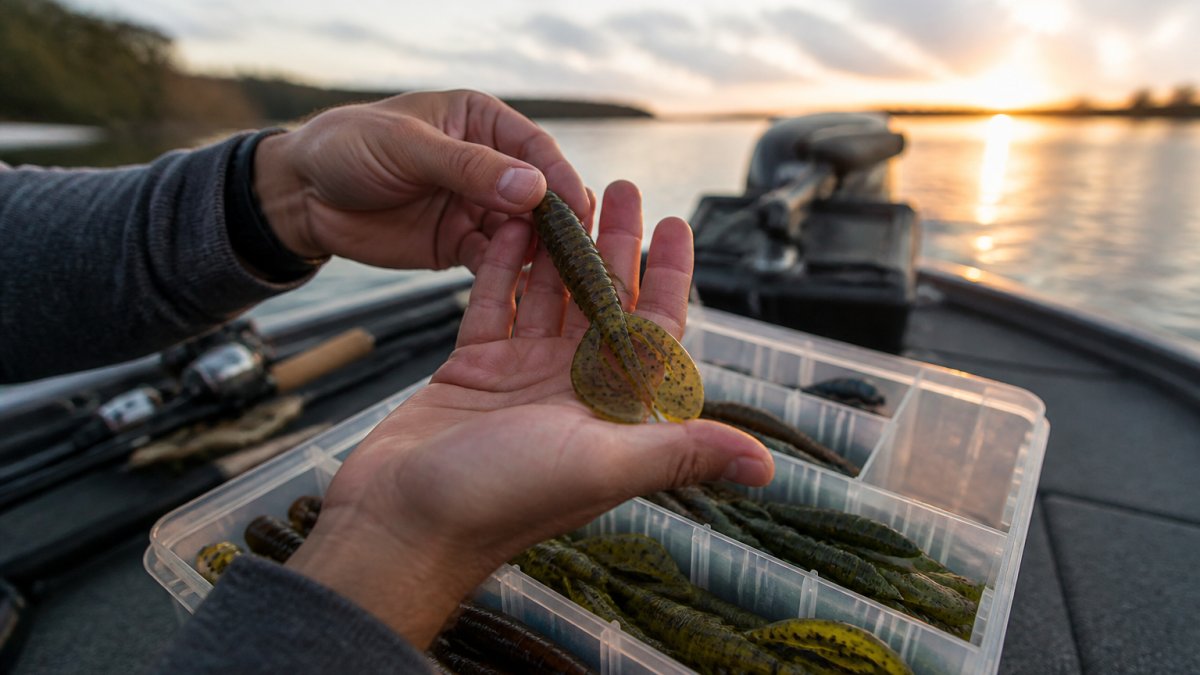
Choosing premium artificial baits comes down to three variables: the action the bait produces, the profile it presents, and whether it matches what bass are actually feeding on in your water. Get those right and price stops mattering much.
Start with water clarity, because it dictates everything downstream:
| Condition | Best Bait Type | Why It Works |
|---|---|---|
| Murky water, low visibility | Creature baits with heavy vibration | Bass hunt by feel and lateral line, not sight |
| Clear water, high pressure | Finesse swimbaits, natural colors | Realistic profile survives scrutiny |
| Stained water, active fish | Paddle-tail swimbaits | Thump and tail kick trigger reaction strikes |
| Heavy cover, shallow | Texas-rigged creature baits | Weedless profile gets into strike zones |
A common mistake is buying for the lake you wish you were fishing instead of the one in front of you. Murky ponds and small water absolutely respond to swimbaits and creature baits, provided you pick colors with contrast and actions with real vibration. Clear-water baits fished in chocolate milk are wasted money.
The other thing most guides miss: durability is a specification, not a marketing line. If you fish around timber and rock, you will lose baits. That is normal. What matters is whether a bait tears apart after two casts or holds up through a full day of contact.
How to Improve Bass Fishing Success with Curated Lure Selection
Improving bass fishing success starts with narrowing your box, not filling it. Tournament anglers carry fewer lure types than weekend anglers, and that is not an accident. Confidence in three or four baits produces better presentations than uncertainty across twenty.
Work through it in this order:
- Identify your home water's clarity and cover. Murky and weedy is a different fishery than clear and rocky.
- Pick one bait per depth zone. A swimbait for mid-column, a creature bait for bottom contact, a topwater for low light.
- Learn each bait's speed range. Most anglers fish swimbaits too fast and creature baits too slow.
- Match color to light, not to preference. Overcast and stained calls for contrast; bright sun and clear water calls for natural tones.
- Log what produced. Date, water temp, bait, and result. Patterns emerge within a season.
- Replace what fails. If a bait has not produced in a full season, it is not your confidence bait.
The anglers who improve fastest are the ones treating lure selection as a system rather than a shopping habit. That is the thinking behind how we stock the store: versatile swimbaits like Ripple Shad and Swim Minnow alongside creature baits designed specifically for triggering large bass.
The Post-Purchase Advantage: What Happens After You Order
Most tackle retailers treat the sale as the finish line. Direct-to-consumer brands treat it as the start of the relationship, and that difference shows up in the operational details most guides never mention: returns handling, loyalty mechanics, subscription replenishment, and a feedback loop that actually reaches the people running production.
Post-purchase lifecycle management is the single most under-covered topic in DTC content, and it is where fishing tackle brands either earn a repeat angler or lose one to a big-box shelf. Research published through the National Library of Medicine found that identifying specific consumer pain points significantly affects operational success for DTC brands.
Here is what that looks like across the four post-purchase stages anglers should expect from a serious DTC tackle brand:
1. Fulfillment and shipping transparency. A curated catalog should ship fast because inventory is narrow. When a bait is backordered, a DTC brand can tell you exactly when the next production run lands, a distributor cannot. Watch for order confirmations that include rigging guidance, not just a tracking number.
2. Returns and defect handling. Soft plastics tear. That is normal. What matters is whether a brand replaces a bait that failed on the second cast or hides behind a restocking fee. A common pattern among strong DTC brands is a no-questions replacement window on manufacturing defects, funded by the margin they saved by skipping the distributor.
3. Loyalty and replenishment. Soft baits are consumables, which makes tackle a natural fit for subscription or auto-replenish models. A well-run DTC brand tracks how often you reorder a specific bait and offers a replenishment cadence, monthly, seasonal, or per-tournament, instead of blasting generic discount codes.
4. Feedback that reaches production. This is the mechanism that keeps a curated catalog curated. When you report that a creature bait tore on heavy cover, that note should reach the person who specs the plastic formula, not disappear into a support queue.
Customer feedback is not decoration. Our 27 Google reviews include notes like Mason Brady's "Really good prices and baits" and Mark Saunders 123's "This place is awesome! Such a large selection and amazing pricing!!" That kind of direct commentary is what shapes what we stock next, and it is the same loop that should shape any DTC tackle brand you buy from.
DTC Financial Metrics Anglers Should Understand Before Buying
Understanding a few DTC financial metrics helps you judge whether a tackle brand will still exist in three years. Customer acquisition cost, lifetime value, contribution margin, and burn rate determine which brands can afford to keep making good product and which ones are burning cash to look busy.
Most DTC guides stop at definitions. Here is what each metric actually means when you are deciding where to spend your tackle budget.
Customer Acquisition Cost (CAC). This is what a brand spends in ads, influencer deals, and promotions to land one new customer. When CAC climbs faster than the average order value, the brand has to either raise prices, cut product quality, or find cheaper acquisition.
Lifetime Value (LTV). This is the total profit a customer generates over the whole relationship, not just the first order. Soft baits are consumables, so a well-run tackle brand should see LTV climb with every reorder. The practical rule most practitioners use is that LTV should be roughly three times CAC for the business to stay healthy without outside funding.
Contribution Margin. This is what is left from each sale after product cost, shipping, and payment fees, before overhead. DTC brands skip the distributor markup, which should mean higher contribution margin per unit. But that advantage disappears fast if the brand is paying for expensive returns, free shipping on low-value orders, or heavy discounting.
Burn Rate. This is how fast a brand spends its cash reserves. Early-stage DTC brands often run at a loss while they build a customer base, which is fine if the LTV math works. It becomes a problem when burn rate stays high and repeat purchases never materialize.
Bain Capital Ventures has argued that many digitally native DTC brands fail because they rely on old rules rather than building genuine defensibility. Casper and Glossier became benchmarks by rewriting consumer engagement and running direct product research, according to Bynder's DTC brand analysis.
What this means when you are deciding where to spend:
- Exclusive product lines signal a brand controls its own manufacturing and can protect contribution margin
- Repeat customers matter more than one-time viral spikes because they prove LTV is real
- Defensible positioning beats generic "we sell fishing stuff" catalogs that compete only on price
- Transparent pricing (fewer permanent discounts) usually means the CAC/LTV math is working without gimmicks
That is the practical case for buying from a specialist rather than a generalist retailer. You are not just buying a lure. You are backing a supply chain and a set of unit economics that answer to you.
Frequently Asked Questions
What are the benefits of buying fishing tackle from a direct-to-consumer brand?
Buying from a direct-to-consumer brand cuts out the middleman, which means lower prices and fresher inventory. You also get access to exclusive lures like Whack Em Lures that aren't sold in big-box stores. DTC brands often use customer feedback loops to improve products faster, and you can order exactly what you need without driving to a tackle shop. Just Lures Fishing carries a curated selection of swimbaits and creature baits trusted by serious anglers.
How do I know which lure to pick for the conditions I'm fishing?
Start by matching the lure to water clarity and cover. In murky water, choose baits with vibration or rattle, like creature baits. In clear water, natural-colored swimbaits work best. For heavy cover, use Texas-rigged creature baits that slide through weeds. If you're unsure, order a small variety pack or ask the retailer for guidance. Just Lures Fishing's curated selection means every lure is field-tested, so you're not wasting money on guesswork.
Why do DTC fishing brands often offer higher quality than mass-market retailers?
DTC brands like Just Lures Fishing source exclusive manufacturing runs for their Whack Em Lures line, meaning each bait is built for specific fishing conditions. That focus on performance over mass production is why anglers see better results.
Is premium tackle worth it for a weekend warrior with limited time on the water?
Yes, because limited time means every cast counts. Cheap lures that tear easily or don't swim right waste precious hours. Premium artificial baits hold up around structure, so you spend less time re-rigging and more time fishing. For 6-8 hours a month on the water, reliability matters more than saving a few dollars.