
7 Ways to Improve Your Bass Fishing Catch Rate
Table of Contents
- Start With a Plan: The 7-Step Framework for a Better Bass Fishing Catch Rate
- How to Find Bass in a Lake by Season, Temperature, and Depth
- Bass Fishing Seasonal Patterns: Adjusting Tactics Month by Month
- Best Lures for Bass Fishing: Matching Lure Choice to Water Clarity and Forage
- Work Cover and Structure Thoroughly With the Right Tackle
- Slow Down on Tough Fishing Days: A Retrieve and Presentation Decision Framework
- Measure Your Catch Rate and Track What Actually Works
- Conclusion: Turn These 7 Habits Into a Higher Bass Fishing Catch Rate
- Frequently Asked Questions
Last Updated: October 9, 2026
Start With a Plan: The 7-Step Framework for a Better Bass Fishing Catch Rate
The 7 ways to improve your bass fishing catch rate come down to one idea: fish with a plan instead of hoping. At Just Lures Fishing, we know anglers fish hard but sometimes fish randomly.
Bass fishing means targeting largemouth and smallmouth bass with artificial lures by reading water conditions, locating fish, and presenting a bait that triggers a strike. Anglers who catch more fish consistently are not lucky.
According to ShopFizmo's 2026 bass fishing trend coverage, advanced bass fishing techniques now emphasize electronic technology as a primary strategy for success. Meanwhile, industry discussion tracked by Omnia Fishing's 2026 industry outlook points to patterning bass quickly and efficiently as the key shift this year.
Here is the framework we would run, in order, on any body of water:
- Build a plan before you launch. Pick two or three areas worth fishing, not ten.
- Find fish by season, temperature, and depth. Start where bass should be, not where you like casting.
- Match lure choice to water clarity and local forage.
- Work cover and structure thoroughly, not quickly.
- Adjust retrieve speed and presentation when bites are absent.
- Slow down on tough days with finesse presentations.
- Track your results so each trip teaches you something.
How to Find Bass in a Lake by Season, Temperature, and Depth
Finding bass in a lake starts with water temperature and depth, not your favorite bank. Bass move predictably as water warms and cools, so start where the temperature puts them.
Reading Water Temperature and Depth for Bass Location
A simple rule: spring means shallow; summer means deeper structure and shade; fall pushes bass shallow to feed on baitfish; winter groups them deep and slow.
- Spring (cool to warming water): fish shallow flats, pockets, and spawning areas
- Summer (warm water): fish deeper points, ledges, and shaded cover, especially early and late
- Fall (cooling water): bass feed aggressively shallow on baitfish schools
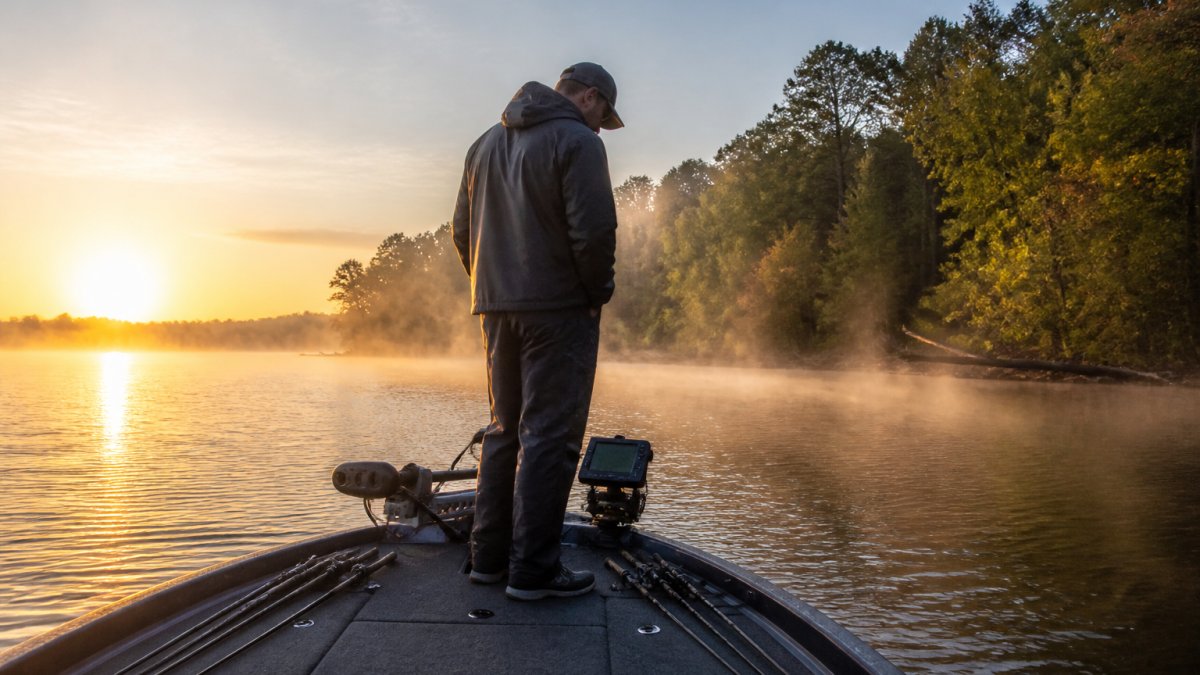
What most guides miss: depth matters more than the calendar. A cold front in May pushes bass deeper than the month suggests. Read the water, not the date.
Bass Fishing Seasonal Patterns: Adjusting Tactics Month by Month
Bass fishing seasonal patterns are the backbone of any plan, because the same lake fishes differently in April than in August. "Fish shallow in spring, deep in summer" is true but incomplete: bass follow water temperature, and the calendar only tells you what the temperature usually is. Here is the systematic method we use to find bass across changing conditions, it starts with a measurement, not a month.
Step 1: Measure Water Temperature Before You Choose a Depth
Take a surface reading at the ramp, then check temperature at 5, 10, and 20 feet with a probe or transducer. Bass sit where the temperature is in their preferred band, roughly 55°F to 75°F for active feeding. When the surface is outside that band, fish are usually deeper.
- Below 50°F: bass group on deep structure, often 20 to 40 feet, and feed in short windows
- 50-60°F: bass move toward staging areas on main-lake points and secondary points
- 60-70°F: the most active band; bass use shallow flats, spawning pockets, and cover
Step 2: Match the Pattern to the Season, Not the Date
Once you know the temperature, the season tells you which direction fish are moving.
Spring (warming water): bass move shallow in waves.
Summer (warm, stable water): bass spread out and feed in windows.
Fall (cooling water): bass school up and chase baitfish hard. Follow the bait, not the bank.
Winter (cold water): bass hold tight to deep structure and demand patience.
Step 3: Read the Transition Weeks, Not Just the Seasons
The toughest and most rewarding fishing happens in the transition weeks, when water warms or cools fast. On a warming trend, fish the shallow side of a break; on a cooling trend, the deep side. The break itself, weed edge, rock ledge, or depth change, is where fish stack.
Step 4: Build a Seasonal Log So the Pattern Compounds
Write down water temperature, depth, and the cover or structure you caught fish from on every trip. After one season, you will see the same temperature bands producing the same depths on your home lake. That is the pattern, and it is worth more than any general article. Anglers who catch bass in every season measure, record, and repeat.
Best Lures for Bass Fishing: Matching Lure Choice to Water Clarity and Forage
The best lures for bass fishing match the local forage and the water clarity in front of you. Lure choice is about size, color, action, and depth, not brand loyalty.
In clear water, bass see everything, so natural presentations and subtle action win.
| Water Clarity | Best Lure Style | Why It Works |
|---|---|---|
| Clear | Suspending jerkbait, finesse worm | Natural profile, subtle action |
| Slightly stained | Square bill crankbait, spinnerbait | Flash plus vibration |
| Murky | Chatter jig, creature bait | Thump and bulk trigger reaction |
| Heavy cover | Hollow body frog | Weedless, topwater strike trigger |
Match lure size to the baitfish you see. If bass are chasing small shad, a big bulky bait can cost you bites.
Our own line reflects that thinking. The Whack Em Jerk 110 is a suspending jerkbait built for clear water and pressured fish, and the Whack Em Chatter Jig carries a precision-tuned vibration blade for stained and murky conditions.

Work Cover and Structure Thoroughly With the Right Tackle
Working cover thoroughly means multiple casts at different angles before you move, with tackle that handles contact with structure. Most anglers fish too fast and move too soon; bass sit tight to cover, and one pass rarely reaches them all.
Fish the Cover, Not Just Around It
A piece of cover is not one target but a set of edges: the shade line, the current seam, the depth change at its base, and the open pocket behind it. Fish each edge before you leave, three casts per piece from three angles, plus a fourth if you saw a follower or swirl. That is often where the biggest bass sits, because pressured fish hold in the least-fished part of the cover.
- Square bill crankbaits deflect off timber and rock, so you can fish contact areas longer without snagging
- Creature baits rigged Texas or Carolina style get into dense cover without snagging, and their bulk displaces water that bass feel through their lateral line
- Frogs fish over matted vegetation where other lures cannot go, and they trigger a topwater strike that is easy to see and time
Match Tackle to the Cover, Not to the Lure
Rod, reel, line, and hook matter as much as the bait in cover. A baitcast reel with enough drag to pull a fish out of cover, paired with a lure that deflects off structure, keeps you fishing instead of re-rigging.
- Heavy cover (mats, thick grass): braided line in the 50-65 lb class, a heavy-action rod, and a high-drag reel
- Wood and rock: fluorocarbon in the 15-20 lb class for abrasion resistance, with a moderate-action rod that loads on the hookset
- Open water around cover: monofilament or fluorocarbon in the 10-12 lb class for a natural presentation
The Whack Em Square Bill Shad dives 0 to 5 feet and its square bill design helps it deflect off submerged timber and rock.

Hookup and Landing Efficiency: The Gap Most Anglers Ignore
Getting bit is only half the job; landing the fish is where catch rate quietly drops. If you get strikes but lose fish, the problem is usually a dull hook, a weak hookset, a drag setting too loose or too tight, or a rod that does not load properly.
- Check hook sharpness before every trip. A hook that drags across a thumbnail without catching is dull. Replace it or sharpen it.
- Set the hook through the fish, not at it. On a Texas rig or jig, reel down until you feel weight, then sweep the rod hard and keep pressure on.
- Set your drag before the first cast. You want enough pressure to drive the hook home but enough give to survive a surge into cover.
Handle and Release Fish So the Cover Stays Productive
A released bass that swims away healthy keeps the spot productive all season. Wet your hands, support the fish horizontally rather than vertically by the jaw, and keep it out of the air only a few seconds. Use a rubberized-mesh net, and unhook with long-nose pliers or forceps while the fish is in the water if you can. Above 80°F, release quickly and consider cutting the line on a deeply hooked fish.
Slow Down on Tough Fishing Days: A Retrieve and Presentation Decision Framework
When bites stop, slow down before you change everything.
If bass are actively chasing: speed up.
If you are getting follows but no strikes: change the retrieve, not the lure.
If you are getting no signs at all: downsize and slow down.
If the water is cold or heavily pressured: fish the slowest presentation you can stand.
The Whack Em Tungsten Ned Jig is built for exactly that last scenario.

Measure Your Catch Rate and Track What Actually Works
Tracking your catch rate separates anglers who improve from anglers who just fish more.
Keep it simple. Note the date, water temperature, clarity, lure, retrieve, and how many fish you landed. After a season, patterns appear that you would never notice from memory alone.
Some experienced anglers argue that becoming better is about the quality of the experience and the decisions you make, not the number of fish caught, a view Wired2Fish contributors have raised in discussions of angling improvement.
- Record water temperature and clarity before your first cast
- Note which lure and retrieve produced each fish
- Mark the depth where fish were caught
Hookups and landing efficiency belong in the same log. If you are getting strikes but losing fish, the problem may be hooksets or drag settings, not lure choice.
Conclusion: Turn These 7 Habits Into a Higher Bass Fishing Catch Rate
The gap between a frustrating day and a productive one is rarely luck. It is a plan, a lure matched to conditions, and the discipline to slow down when the bite tells you to.
At Just Lures Fishing, we carry a curated selection of hard and soft baits we trust and use ourselves, including the exclusive Whack Em Lures line made just for us. From the Whack Em Jerk 110 for clear-water suspending presentations to the Whack Em Brush Hawg 6" for punching dense cover, our goal is to give you the best chance of success with every cast.
Get started with Just Lures Fishing and build a tackle box that helps you catch more bass on your next trip.
Frequently Asked Questions
What is the 80/20 rule in bass fishing?
The 80/20 rule suggests that roughly 80% of bass are caught from about 20% of the water. Instead of casting across an entire lake, focus on the spots that offer cover, structure, and a food source. In practice, this means slowing down and working a single piece of cover thoroughly, such as a fallen tree or dock, rather than racing from spot to spot. Anglers who apply this principle often see their bass fishing catch rate climb because they spend more time in the strike zone.
What lures are best for increasing bass catch rates?
The best lures for bass fishing depend on conditions, but a few categories cover most situations. A square bill crankbait like the Whack Em Square Bill Shad ($7) deflects off shallow structure and covers water fast. A spinnerbait ($6) works well in stained water and around cover. For finesse on pressured fish, a Tungsten Ned Jig ($6) paired with a soft plastic gets subtle bites. Matching lure choice to water clarity and local forage matters more than any single lure.
How does water temperature affect bass fishing success?
Water temperature drives where bass sit and how aggressively they feed. In spring, bass move shallow to spawn when water reaches the mid-50s to mid-60s Fahrenheit. In summer, they often hold deeper during the day and feed shallow at dawn and dusk. In fall, they follow baitfish back into creeks and flats. In winter, they slow down and group tight on deep structure. Tracking temperature helps you find bass in a lake faster and choose the right presentation.
How can I catch more bass on tough, pressured days?
On tough days, downsize your lure and slow your retrieve. A Ned rig with a Tungsten Ned Jig ($6) and a small soft plastic gets bites when bass have seen everything else. Fish the same piece of cover multiple times from different angles. Also, try a silent topwater like the Plopper 90 ($8) in clear, calm water where noisy lures spook fish. Tracking which tactics produce on pressured days helps you repeat them next time.